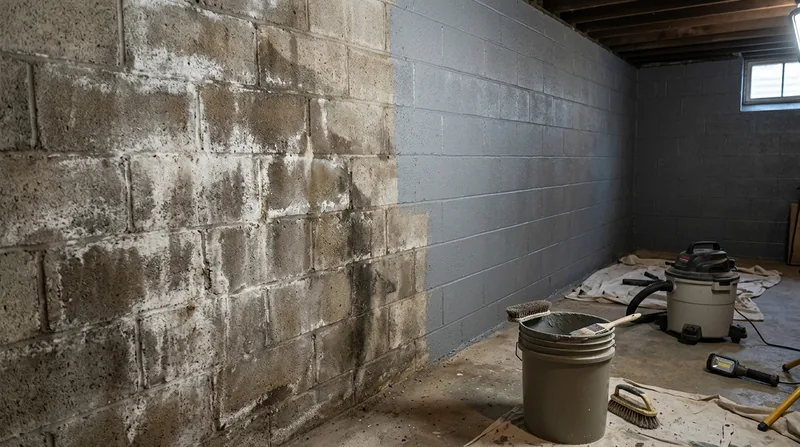




Basement Wall Sealing in Wilmington: Stop the Damp Before It Spreads
Wilmington sits where the Brandywine meets the Christina River, and that geography shows up in the basement walls of Trolley Square rowhouses, the foursquares off Price's Run, and the 1940s ranches out toward Elsmere and Bellefonte. Much of the ground here is weathered Piedmont rock and silty clay that holds spring rain and sheds it slowly, so basement wall sealing in Wilmington has to be matched to what the wall is actually doing. If you have efflorescence blooming on brick, a musty smell that returns every July, or a white chalky film on block walls, a penetrating sealer can solve that. If water is pushing in at the cove joint after a nor'easter, sealing alone will not hold it back, and we tell you that on the first visit.
We prep the surface, remove efflorescence, and apply the right sealer or membrane for your wall type, whether that is old fieldstone, early block, or poured concrete. Where the real problem is hydrostatic pressure from a high water table near the rivers, we say so plainly and point you to the correct fix. Start with a free basement inspection so we can tell you which problem you actually have.
Why Basement Wall Sealing Matters in Wilmington's Older Housing Stock
Most of Wilmington's below-grade problems start with the building stock, not the weather alone. The 1880s to 1930s rowhouses in Little Italy and Trolley Square were built with brick walls over fieldstone or early block foundations, and many still drain through old clay tile that has cracked or silted shut. Freeze-thaw cycles open hairline cracks in that masonry every winter, and the humid summers pull moisture through the same paths. Sealing those walls correctly slows surface dampness and stops the chalky bloom, but it is not a substitute for drainage when groundwater is the driver.
- Efflorescence on brick and block tells you moisture is moving through the wall and leaving salt behind.
- Hairline cracks from freeze-thaw cycles let in dampness that a penetrating sealer can close off.
- Damp walls in humid summers feed musty odors, and sealing is one part of moisture control.
- Water at the cove joint after heavy rain points to hydrostatic pressure, not a surface problem.
- Older clay tile drains under 1920s foundations often fail and need evaluation before sealing.
We look at all of these before quoting, because sealing a wall that is actively taking water is a waste of your money and ours.
Key info: A homeowner on a 1920s brick rowhouse near Price's Run had efflorescence on the north wall every spring. We removed the bloom, applied a penetrating sealer, and extended the downspouts. Two seasons later the wall stayed dry, but the cove joint seepage in the back corner needed an interior drain tile system, which we quoted separately and honestly.
For a wider look at how sealing fits with drainage and crack repair, see the basement waterproofing overview. Delaware homeowners can also verify contractor licensing through the Delaware Division of Professional Regulation before hiring anyone.
How We Seal Basement Walls in Wilmington, Step by Step
Our process starts with diagnosis, not a sealer bucket. We walk the basement, check the wall type, look for efflorescence and active seepage, and test whether the moisture is surface condensation or groundwater pushing through. Only then do we choose a penetrating sealer for masonry or a membrane product for block and poured walls. If we find a structural issue like a bowing wall, we stop and tell you, because sealing over a moving wall hides a problem instead of fixing it.
- We inspect the wall, the cove joint, and the floor perimeter to identify the moisture source.
- We remove efflorescence, loose mortar, and any failing parging so the sealer can bond.
- We clean and prep the surface according to the product spec for brick, block, or poured concrete.
- We apply the penetrating sealer or membrane in the correct number of coats for the wall type.
- We check grading and downspout extensions outside, since roof water at the foundation undoes good sealing.
- We document what we found and recommend drainage work if hydrostatic pressure is the real driver.
Each step is documented so you know exactly what was applied and why, and so the next contractor can pick up where we left off if you ever need one.
Key info: On a 1950s split-level in Hockessin, the block walls were damp but not leaking. We sealed the walls, replaced a failed downspout extension, and corrected the grading. The homeowner did not need excavation, and we told them so before they spent a dollar on it.
If the inspection shows water at the floor perimeter rather than the wall face, the better answer is usually an interior drain tile system, which we install as a separate scope.
Sealing Approaches We Use on Wilmington Basement Walls
Not every wall takes the same product, and the table below shows how we match the approach to the wall and the problem. We choose based on wall material, moisture source, and whether the wall is stable. If the wall is bowing or the crack is structural, sealing is not the answer and we say so.
| Approach | Description | Best for |
|---|---|---|
| Penetrating sealer | Soaks into brick or block and reacts with the masonry to block capillary moisture. | Damp walls with efflorescence and no active seepage. |
| Cementitious membrane | A troweled or sprayed coating that forms a waterproof skin on the wall face. | Poured concrete and block walls with minor surface moisture. |
| Crystalline waterproofing | A coating that grows crystals into cracks and pores to close them from inside the concrete. | Hairline cracks and porous concrete in older Wilmington foundations. |
| Epoxy or polyurethane injection | Ports are set into a crack and resin is injected to fill and seal it. | Active leaks and cracked walls that need structural crack repair. |
| Interior drain tile and sump | A perimeter drain and sump basin collect groundwater and discharge it outside. | Hydrostatic pressure and water at the cove joint after heavy rain. |
The wrong product on the wrong wall wastes money and can trap moisture, so we match the method to the diagnosis, not to a sales target.
Basement Wall Sealing Cost in Wilmington: What to Expect
Most residential basement wall sealing jobs in Wilmington start around $1,500, and that figure covers surface prep, efflorescence removal, and sealer application on a typical wall run. The price moves up with square footage, wall condition, and how much prep the masonry needs. Old fieldstone and rough block take more material and labor than poured concrete. If the inspection finds active seepage or hydrostatic pressure, the number changes because the fix changes, and we tell you that before you commit.
We quote sealing as its own scope so you can compare it directly against drainage work. If the honest answer is that an interior perimeter drain is the better spend, we say so. Getting two or three estimates is smart in this market, and so is asking each contractor what they found and why they chose their method. The full pricing overview breaks down the ranges by scope.
Hiring a Basement Wall Sealing Contractor Near Me in Wilmington
You want a contractor who will tell you when sealing is enough and when it is not. Ask for proof of licensing and insurance, get two or three written estimates, and ask each one what they found at the wall. Check references from Wilmington neighborhoods with housing stock like yours, since a 1920s rowhouse and a 1960s ranch need different approaches. Permits are commonly required for structural foundation repair and for work that alters drainage or the sanitary connection of a sump discharge, and the rules vary by jurisdiction, so verify with the local building department before work starts.
If you want a straight answer about your wall, contact us and we will schedule a free inspection and give you a written scope.
Basement Wall Sealing in Wilmington: Pricing Guide
| Service | Price | Details |
|---|---|---|
| Penetrating sealer on masonry walls | Starting at $1,500 | Includes efflorescence removal, surface prep, and sealer application on a typical basement wall run. |
| Cementitious membrane or crystalline coating | Starting at $2,200 | Includes wall prep and two-coat application, priced by square footage and wall condition. |
| Epoxy or polyurethane crack injection | Starting at $650 | Includes port setting, resin injection, and cleanup for an active or structural crack. |
| Sealing plus drainage correction | On estimate | Needs an on-site look when hydrostatic pressure or failed drain tile is driving the moisture. |
| Travel | Included | In Wilmington and surrounding areas, no separate call-out or mileage fee. |
| Estimate | Free | Response within 24h at (302) 573-9185, no obligation to book. |
Indicative pricing, the exact cost depends on square footage, finish, and site access. Free personalized estimate within 24h at (302) 573-9185.


