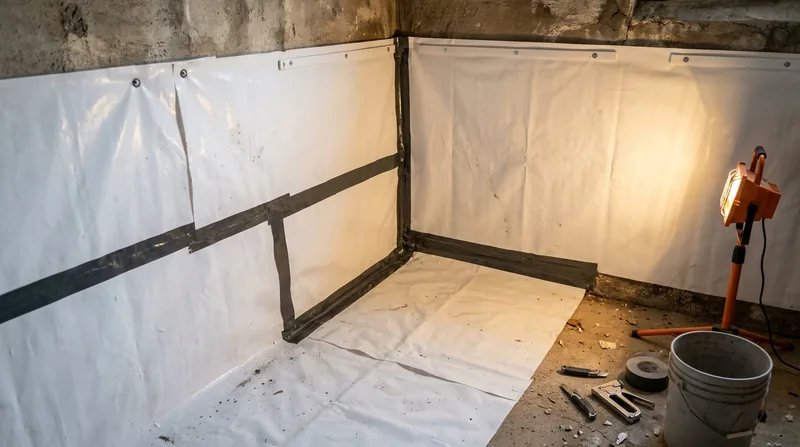




Wilmington sits where the Brandywine meets the Christina River, and the ground under most of the city is weathered Piedmont rock capped with silty clay that holds water in spring and sheds it slowly. In the 1880s-1930s rowhouses and foursquares of Trolley Square, Little Italy, and Price's Run, full basements sit under brick walls on fieldstone or early block foundations, and the high water table near the rivers pushes groundwater vapor straight into the lower level. Vapor Barrier Installation in Wilmington is the below-grade step that stops that ground moisture from migrating through walls and slab once drainage and crack work are done. We install heavy-duty barrier sheets with sealed seams and taped terminations, integrated with your sump basin and discharge line where needed. If you are still mapping the whole system, start with our basement waterproofing service and we will tell you plainly whether a vapor barrier alone is enough.
Why Vapor Barrier Installation Matters in Wilmington's Old Brick and Block Basements
Ground moisture vapor is the quiet problem behind most musty basement smells in Wilmington. The silty clay and glacial clay soil around the city stays damp long after a nor'easter or a heavy summer downpour, and that moisture moves through fieldstone mortar, early block, and poured walls as vapor, not just as liquid. Once it reaches the interior face, it feeds efflorescence, paint failure, and surface mold growth on framing and stored goods.
- The high water table near the Christina and Brandywine keeps lower walls damp year-round in river-adjacent neighborhoods like Little Italy and the streets off Price's Run.
- Freeze-thaw cycles open hairline cracks in old masonry, giving vapor an easy path into the basement air.
- 1940s-1960s ranches and split-levels in the outer neighborhoods have block or poured walls that wick moisture steadily through the block cores.
- Older clay tile drains under many rowhouses are cracked or silted, so water sits against the footing instead of draining away.
- Hillside walkout lots in the north collect water on the uphill side, and that pressure drives vapor through the lower wall.
A vapor barrier closes the interior face to that vapor, but it only works when the water behind it has somewhere to go, which is why we check drainage first.
Key info: In a Trolley Square rowhouse with a fieldstone foundation, we often find efflorescence and a musty smell with no visible standing water. That pattern points to vapor migration, and a sealed barrier over the wall and slab is the right fix once the footing drain is confirmed to be moving water.
For official context on how basement and foundation work is regulated in the city, check the City of Wilmington licensing and permits pages before any structural or drainage alteration.
How We Install Vapor Barriers in Wilmington Basements
We start by reading the basement, not by selling a sheet of plastic. The order of work matters in Wilmington's older housing stock: if hydrostatic pressure is pushing water through the wall or up through the slab, a barrier installed over a wet wall traps moisture and fails. We confirm the drainage path first, then install the barrier so it stays dry on the interior face.
- We inspect the walls, slab, and footing drain, and we check the sump basin and pump for function before recommending any barrier.
- We address active seepage first with crack injection or wall sealing, so the barrier goes over a stable surface.
- We grade and clean the wall face, remove loose parging, and treat efflorescence so the adhesive and fasteners hold.
- We install heavy-duty barrier sheets with dimple board where the wall needs a drainage gap, running them down to the slab and sealing seams with compatible tape.
- We terminate the barrier at the slab and integrate it with the sump basin and interior perimeter drain so collected moisture reaches the pump.
- We test the sump pump and check valve, confirm the discharge line runs clear of the foundation, and walk you through what the barrier does and does not do.
Every installation ends with a wet-test of the sump system and a written summary of what we found behind the barrier.
Key info: On a 1950s split-level in Claymont, the block wall read damp from the footing up to about four feet. We repaired the footing drain connection, installed a sealed barrier with dimple board, and tied it into a new sump basin. Two seasons later the wall face stays dry and the musty smell is gone.
If the inspection shows the footing drain is finished, we will say so and quote drain tile repair and replacement before any barrier goes up.
Vapor Barrier Approaches We Use in Wilmington
Not every basement needs the same barrier. The right approach depends on the wall material, whether the slab is wet, and whether drainage is already in place. The table below shows the options we install most in Wilmington and the outer neighborhoods.
| Approach | Description | Best for |
|---|---|---|
| Wall sheet barrier with sealed seams | Heavy-duty sheet fastened to the wall, seams taped, terminated at the slab. | Block and poured walls with vapor migration but no active seepage. |
| Dimple board drainage gap | Barrier with a drainage core that lets moisture fall to the perimeter drain. | Fieldstone and damp block walls where the face stays wet. |
| Slab vapor barrier | Sheet laid over the slab and sealed at the wall termination. | Basements with damp floors and no slab crack seepage. |
| Barrier integrated with sump basin | Barrier tied to the sump basin and interior perimeter drain. | Basements with a sump system or high water table near the rivers. |
| Barrier over repaired cracks | Crack injection completed first, then barrier installed over the repaired wall. | Walls with injected cracks and residual vapor migration. |
We choose the approach after the inspection, and we explain why one option fits your wall better than another.
Vapor Barrier Installation Cost in Wilmington: What to Expect
Pricing for vapor barrier work starts at $3 per square foot, and that figure covers the barrier material, seam sealing, and standard terminations. The final number moves with wall height, the condition of the wall face, whether dimple board is needed, and whether the barrier has to tie into an existing sump basin or a new interior perimeter drain. A simple slab barrier in a dry 1950s ranch in Elsmere sits near the low end, while a full wall-and-slab installation in a damp fieldstone rowhouse basement runs higher.
Access matters too. Narrow basement stairs and low headroom in older Wilmington rowhouses slow the work, and removing failed parging adds labor before the barrier can go up. If the inspection finds active seepage, crack repair or drainage work is quoted separately so you can see exactly what each item costs. Get two or three written estimates and compare scope, not just the number.
Our full pricing overview breaks down the line items we use across basement waterproofing work.
What to Look For in a Waterproofing Contractor Near Me in Wilmington
Hiring for below-grade work is a trust decision, because most of the work disappears behind a barrier and you will not see it again. A contractor who specializes in basements will tell you when a barrier is not the right answer, and that honesty is the first thing to look for.
- Confirm the contractor is licensed and insured, and ask for a certificate of insurance before work starts.
- Get multiple estimates in writing, and make sure each one lists the same scope so you can compare fairly.
- Ask for references from Wilmington jobs with the same wall type as yours, and call them.
- Ask who pulls the permit when the work touches structural repair or alters drainage, and verify the rule with the City of Wilmington building department since thresholds vary.
- Check any HOA requirements for exterior work, discharge line routing, or access before the crew arrives.
If a quote promises a lifetime warranty or skips the inspection, keep looking. We offer a transferable warranty and put the scope in writing.
Reach out through our contact page to schedule a free basement inspection and get a straight answer on whether a vapor barrier is the right next step.
Vapor Barrier Installation in Wilmington: Pricing Guide
| Service | Price | Details |
|---|---|---|
| Slab vapor barrier only | Starting at $3/sq ft | Covers barrier sheet, seam sealing, and slab-to-wall terminations in a dry basement. |
| Wall and slab barrier | Starting at $4.50/sq ft | Full wall coverage with taped seams and slab termination; wall height and access move the price. |
| Barrier with dimple board | Starting at $5.50/sq ft | Adds drainage core behind the barrier for damp fieldstone or block walls that stay wet. |
| Barrier integrated with sump system | On estimate | Requires tying the barrier into the sump basin and perimeter drain, so we price it after inspection. |
| Travel | Included | in Wilmington and surrounding areas, no separate call-out or mileage fee |
| Estimate | Free | Response within 24h at (302) 573-9185, no obligation to book |
Indicative pricing, the exact cost depends on square footage, finish, and site access. Free personalized estimate within 24h at (302) 573-9185.


