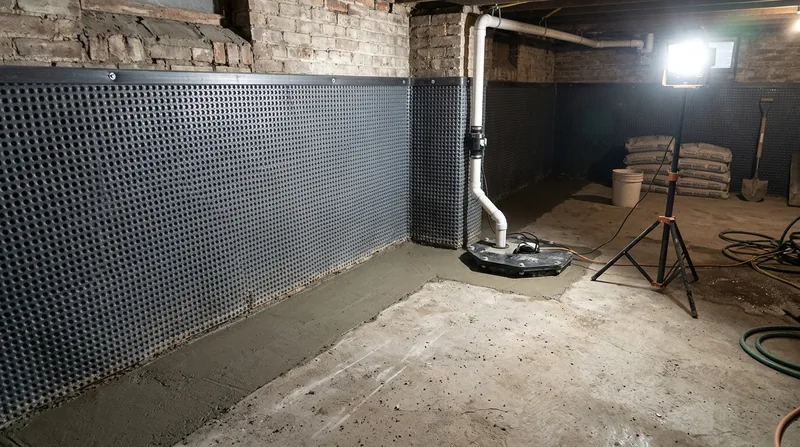




Basement Waterproofing in Wilmington: Stop the Water at the Source
Wilmington sits where the Brandywine meets the Christina River, and that geography defines what happens under your house. The 1880s to 1930s rowhouses in Trolley Square, Little Italy, and Price's Run were built with full basements under brick walls, often on fieldstone or early block footings with clay tile drains that have long since collapsed. Basement Waterproofing in Wilmington starts with understanding that ground, not with a tube of sealer.
Much of the city rests on weathered Piedmont rock and silty clay. That soil holds spring rain like a sponge and sheds it slowly, while the high water table near the rivers pushes groundwater up into lower walls and floor joints. Nor'easters and heavy summer downpours send water into low yards and street-side basements, and freeze-thaw cycles keep opening cracks in old masonry. We trace the actual water path before we quote a system. Call (302) 573-9185 or start with a free basement inspection.
Why Basement Waterproofing Matters in Wilmington's Older Housing Stock
Older Wilmington homes were not built with modern drainage in mind. A fieldstone footing laid in 1910 has no footing drain worth the name, and the clay weeping tile that was installed has usually silted shut or cracked at the joints. When the silty clay around that foundation stays saturated after a March thaw, the water has nowhere to go but through the wall.
- Hydrostatic pressure builds against block and brick walls when the water table rises near the Christina and Brandywine, forcing water through mortar joints and the floor-wall seam.
- Efflorescence, that white chalky bloom on basement walls, tells you water is moving through the masonry and evaporating on the inside face.
- Older drain tile and footing drains in Trolley Square and Little Italy have often collapsed or root-clogged, so they no longer carry water away from the footing.
- Freeze-thaw cycles in January and February open hairline cracks in poured walls and spall the face of old brick, widening the path for spring seepage.
- 1940s to 1960s ranches and split-levels in the outer neighborhoods have block or poured walls that crack at the cold joint and seep along the cove.
Each of those symptoms points to a different fix, which is why a wet basement is a diagnostic problem before it is a repair problem.
Key info: A homeowner in Price's Run called us after every heavy rain left a half inch of water on the floor. The walls were dry. The water was rising through the floor-wall joint because the old clay drain tile under the slab had collapsed. An interior perimeter drain and sump basin solved it without digging up the yard.
For the official view on permits and what work requires a filing, check the City of Wilmington Department of Licenses and Inspections before any structural or drainage work begins.
How We Waterproof a Wilmington Basement: Diagnosis First, Then the System
We do not sell a system on the first visit. We walk the basement, read the walls, check the floor joint, test the sump basin, and look at the grading and downspouts outside. Then we tell you which water path is actually flooding the space, because an interior drain tile system and an exterior excavation solve different problems.
- We inspect the interior walls, floor seam, window wells, and any existing sump pit, and we note efflorescence patterns and crack orientation.
- We check exterior grading, downspout discharge, and the condition of the footing drain on the uphill side of the house.
- We identify the water source: rising groundwater, hydrostatic pressure at the footing, a failed drain tile, or wall seepage through masonry.
- We recommend the least invasive system that solves it, whether that is crack injection alone or a full interior perimeter drain with sump pump.
- We pull the required permits where the work touches structural repair, egress, or sump discharge connections, and we schedule the install around your occupancy.
- We test the finished system with water before we leave and show you how the pump, check valve, and discharge line operate.
When the water is coming through a single vertical crack and the walls are otherwise sound, foundation crack repair with epoxy or polyurethane injection is often the whole job. When the floor joint weeps across the entire perimeter, an interior drain tile system is the better answer than excavating the exterior.
Key info: A split-level in Hockessin on a hillside lot had a walkout wall that seeped after every nor'easter. The exterior grade sloped toward the house and the downspouts dumped at the foundation. We corrected the grading, extended the downspouts, and sealed the wall, and the seepage stopped without excavation.
Waterproofing Approaches We Use in Wilmington Basements
There is no single waterproofing method that fits every Wilmington basement. The right approach depends on whether water is rising under the slab, pushing through the wall, or running down the outside of the foundation. Here is how the main approaches compare.
| Approach | Description | Best for |
|---|---|---|
| Interior perimeter drain | A drain channel cut along the floor-wall joint that collects water and routes it to a sump basin. | Rising groundwater and a weeping floor joint across the whole perimeter. |
| Exterior excavation and membrane | Dig down to the footing, repair the drain tile, apply a waterproof membrane and dimple board. | Failed footing drain and wall seepage where the exterior is accessible. |
| Crack injection | Epoxy or polyurethane injected through ports to fill and seal a single crack. | Isolated vertical cracks in poured or block walls with no perimeter seepage. |
| Wall sealing and vapor barrier | Parging, masonry sealer, and a vapor barrier to control moisture through the wall face. | Damp walls, efflorescence, and humid summer air in older rowhouse basements. |
| Sump pump and battery backup | A sump basin, primary pump, check valve, and battery backup to move collected water out. | Any system that collects water and needs to discharge it during a power outage. |
We match the approach to the water path, not to a package, and we tell you when a smaller repair will do the job.
Basement Waterproofing Cost in Wilmington: What to Expect
Most Wilmington basement waterproofing projects start at From $2,500 and move up from there based on the length of the perimeter, the wall material, and whether the job needs a new sump pump and discharge line. A single crack injection on a poured wall in Elsmere is a small job. A full interior perimeter drain under a 1920s rowhouse in Little Italy with a collapsed clay drain tile is a larger one.
The factors that move the number are the linear feet of drain, the depth of the footing, whether the floor is slab or old brick, access for equipment, and whether the discharge line has to be routed to a legal outlet. We also price battery backup separately because a power outage during a nor'easter is exactly when the primary pump quits. Getting two or three estimates is smart, and a contractor who will not explain the water path in plain language is a red flag.
Our full pricing overview breaks down the ranges by system type so you can compare quotes apples to apples.
Basement Waterproofing Near Me: How to Choose a Contractor Near Wilmington
Plenty of outfits will quote a waterproofing job in Wilmington without ever diagnosing the water source. A good contractor walks the basement, checks the exterior grade, and tells you what is actually failing. Use this checklist before you sign anything.
- Confirm the contractor is licensed and insured and ask for the certificate, not just a verbal assurance.
- Get at least two or three written estimates that describe the system, the materials, and the warranty terms in writing.
- Ask for local references from Wilmington or New Castle County jobs you can actually call.
- Ask who pulls the permit when the work touches structural foundation repair or alters the sump discharge connection, and verify the rule with the city building department.
- Read the warranty language carefully. A transferable warranty is standard, but no one can promise a lifetime on a system.
If a quote arrives before anyone has looked at the floor joint or the footing drain, keep shopping. Reach us through the contact page to schedule a walkthrough.
Basement Waterproofing in Wilmington: Pricing Guide
| Service | Price | Details |
|---|---|---|
| Crack injection (single crack) | Starting at $2,500 | Epoxy or polyurethane injection with ports, includes surface prep and cleanup on one wall crack. |
| Interior perimeter drain and sump | Starting at $4,500 | Drain channel along the floor joint, sump basin, primary pump, and check valve for an average basement. |
| Exterior excavation and membrane | On estimate | Requires an on-site look at footing depth, access, and existing drain tile condition before pricing. |
| Battery backup sump pump | Starting at $650 | Backup pump, battery, and alarm added to an existing sump basin for power-outage protection. |
| Travel | Included | In Wilmington and surrounding areas, no separate call-out or mileage fee. |
| Estimate | Free | Response within 24h at (302) 573-9185, no obligation to book. |
Indicative pricing, the exact cost depends on square footage, finish, and site access. Free personalized estimate within 24h at (302) 573-9185.


