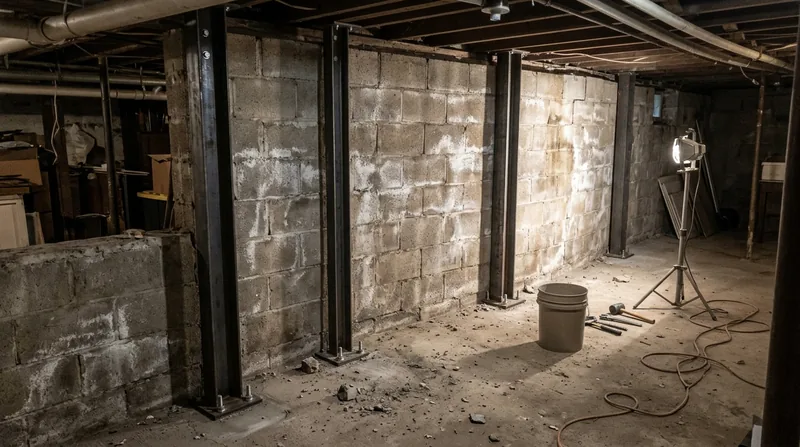




Bowing Wall Repair in Wilmington
Wilmington sits where the Brandywine meets the Christina River, and the ground under most of the city is weathered Piedmont rock and silty clay that holds water all spring. That means bowing wall repair in Wilmington is rarely a cosmetic problem. A brick rowhouse wall in Trolley Square or Little Italy can lean a half inch over a single winter, and a block wall in a 1950s ranch out toward Elsmere can bow inward once the clay behind it stays saturated.
We read the movement before we touch the wall. A crack that lets water in is one job. A wall that has actually rotated or bowed under hydrostatic pressure is another, and it needs carbon fiber straps, steel I-beams, or wall anchors sized to the load behind it. If you are still at the seepage stage, start with foundation crack repair and save the structural work for a wall that has really moved.
Why Bowing Walls Show Up So Often in Wilmington's Older Neighborhoods
The building stock here is the reason. Most of the rowhouses and foursquares in Price's Run and the Riverfront blocks went up between 1880 and 1930 with full basements under brick walls, and many sit on fieldstone or early block footings with clay tile drains that have long since collapsed. When those drains stop carrying water, the soil stays wet, the clay swells, and the pressure pushes inward on a wall that was never engineered for it. Freeze-thaw cycles through a Delaware winter open the mortar joints and give the water a path in.
- Hydrostatic pressure from saturated silty clay pushes against the wall face all spring and shows up as a horizontal crack at mid-height.
- Collapsed clay tile drain tile and blocked footing drains let water pool at the base of the wall instead of carrying it away.
- Freeze-thaw cycles crack old brick and mortar, and each thaw lets more water into the wall body.
- Downspouts that dump next to the foundation and grading that slopes back toward the house soak the same soil the wall is fighting.
- Efflorescence and white salt bloom on the interior face tell you water is moving through the masonry, not just sitting on it.
Any one of those is manageable on its own. Two or three together are what turn a straight wall into a bowing one.
Key info: On a 1920s brick rowhouse near Little Italy, we routinely find a horizontal crack at mid-wall with visible inward movement of a quarter to three quarters of an inch. That is the point to call, not the point to patch and paint over.
Structural foundation repair in Delaware is permitted work, and the rules vary by jurisdiction, so confirm the current requirements with the Delaware building department having jurisdiction before any strap or anchor goes on the wall.
How We Diagnose and Stabilize a Bowing Wall in Wilmington
We start by measuring the movement, not guessing at it. A plumb line and a level tell us how far the wall has gone and in which direction, and we map the crack pattern to see whether the wall is rotating at the top, bowing at mid-height, or sliding at the base. Then we look at what is pushing it: the water table near the rivers, a failed drain tile, or a downspout dumping into the same clay. The fix depends on which of those is true.
- We inspect the interior wall face and the exterior grade, and we record crack width, offset, and plumb at several points along the wall.
- We identify the water source behind the wall, whether that is a high water table, a blocked footing drain, or surface water from grading and downspouts.
- We match the repair to the severity: carbon fiber straps for a wall that has bowed slightly, steel I-beams for a wall carrying heavier load, wall anchors where the wall has to be pulled back toward plumb.
- We relieve the water pressure so the repair is not fighting a wet clay bank, which often means an interior perimeter drain and a sump basin with a check valve on the discharge line.
- We close the wall and verify the movement has stopped before we call the job done.
If the wall has not moved and you only have seepage, we will tell you that, because a strap on a straight wall is money spent for nothing.
Key info: A split-level in Brookside came in with a block wall bowed about an inch and a half after a hard February freeze. The footing drain was silted solid. We installed steel I-beams, cleared the drain line, and added a sump basin, and the wall has held plumb since.
For walls that also need the water managed before the structural work, the interior drain tile system is usually the answer, because it relieves pressure from inside without excavating a mature yard.
Repair Approaches We Use and When Each One Fits
There is no single right repair for every bowing wall. The choice comes down to how far the wall has moved, how much load it carries, and whether the water behind it can be controlled from inside or has to be dealt with from outside. Here is how we match the method to the wall.
| Approach | Description | Best for |
|---|---|---|
| Carbon fiber straps | Straps bonded to the interior wall face and anchored into the floor and rim above, holding the wall against further inward movement. | Slight to moderate bowing on block or poured walls with no rotation at the top. |
| Steel I-beams | Vertical steel beams set against the wall and tied into the footing and floor structure to carry heavy lateral load. | Walls with significant bowing or a brick wall that has lost mortar and section. |
| Wall anchors | Anchors set in the exterior soil, connected through the wall to an interior plate, that can pull the wall back toward plumb. | Walls that have rotated or leaned and need to be straightened, not just held. |
| Drainage relief plus repair | Interior perimeter drain and sump basin installed with the structural repair so the wall is not fighting saturated clay. | Walls where a high water table or failed drain tile is the driver. |
Most Wilmington jobs combine two of these. The structural repair stops the movement, and the drainage work removes the pressure that caused it.
Bowing Wall Repair Cost in Wilmington: What to Expect
Pricing starts at $600 for a limited repair, such as a small section of wall that needs strapping and crack sealing, and climbs from there based on how much wall has moved and how much water has to be managed. A full wall of carbon fiber straps on a rowhouse basement runs higher, and wall anchors or steel I-beams run higher still because of the excavation and the steel. The water side of the job, an interior perimeter drain or a sump basin, is priced separately because it depends on the length of wall involved.
What moves the number: the length and height of the affected wall, whether the wall is brick, block, or poured concrete, how far it has bowed, whether the repair has to pull the wall back or only hold it, and how much excavation the anchors require. Access matters too. A basement in Hockessin with a walkout and a clear exterior face is easier to work than a tight rowhouse basement off Price's Run with no rear access. Get two or three estimates on the same scope, and make sure each one states whether drainage work is included.
The full breakdown of what we charge and how we structure it is on our pricing page.
Choosing a Bowing Wall Repair Contractor Near Me in Wilmington
Ask three things before you sign anything: is the company licensed and insured for structural foundation work in Delaware, will they show you the measurements that justify the repair they are proposing, and do they separate the structural fix from the drainage fix so you can see what each one costs. A contractor who straps a wall without addressing the water behind it is selling you a repair that will not hold.
Ask for references from jobs in your neighborhood and call them. Ask who pulls the permit, because structural foundation repair in Wilmington commonly requires one and the rules vary by jurisdiction, so the building department has the final word. If your block has an HOA, check whether exterior excavation for anchors needs approval before the crew shows up. And get the certificate of insurance in writing, not just a verbal yes.
You can reach us through our contact page to set up a free basement inspection and get a written scope before any work starts.
Bowing Wall Repair in Wilmington: Pricing Guide
| Service | Price | Details |
|---|---|---|
| Limited wall strapping and crack sealing | Starting at $600 | Covers a short section of wall with carbon fiber straps and sealed cracks; length of wall moves the price. |
| Full wall carbon fiber strapping | Starting at $1,800 | Straps across an entire basement wall, anchored to floor and rim; wall height and access drive cost. |
| Steel I-beam or wall anchor system | On estimate | Heavy-load repair or pulling a wall back to plumb; needs an on-site look at movement and soil. |
| Drainage relief with structural repair | On estimate | Interior perimeter drain and sump basin added to the repair; priced by wall length and discharge route. |
| Travel | Included | In Wilmington and surrounding areas, no separate call-out or mileage fee. |
| Estimate | Free | Response within 24h at (302) 573-9185, no obligation to book. |
Indicative pricing, the exact cost depends on square footage, finish, and site access. Free personalized estimate within 24h at (302) 573-9185.


