



Foundation Crack Repair in Wilmington
Foundation Crack Repair in Wilmington starts with understanding what the ground under your house is doing. Wilmington sits where the Brandywine meets the Christina River, and much of the ground here is weathered Piedmont rock and silty clay that holds water in spring and sheds it slowly. In Trolley Square, Little Italy, and Price's Run, 1880s to 1930s rowhouses and foursquares have full basements under brick walls, with fieldstone or early block foundations and old clay tile drains. Out in the 1940s to 1960s ranches and split-levels, you find block or poured walls, and the newer hillside lots up north have walkouts. A high water table near the rivers pushes groundwater into lower walls, and freeze-thaw cycles open cracks in old masonry. We inspect every crack, match it to the right repair method, and tell you plainly when simple sealing is enough and when hydrostatic pressure is the real problem. Call (302) 573-9185 to book a free basement inspection.
Why Foundation Cracks Open in Wilmington's Old Brick and Block Basements
The failure mode that dominates in Wilmington is not one dramatic event. It is the slow cycle of wet silty clay swelling against a foundation in spring, then freeze-thaw in January and February working the same seam open again. Old brick and fieldstone walls in the river neighborhoods were laid with lime mortar that softens as it stays damp, and early block walls crack along the mortar joints first. Add nor'easters and heavy summer downpours that send water into low yards and street-side basements, and a hairline crack becomes a wet basement fast. Here is what we see most often:
- Vertical cracks in poured walls, usually at the center of a wall panel where the concrete cured and shrank.
- Stair-step cracks following the mortar joints in block and brick, which often point to footing movement rather than simple shrinkage.
- Horizontal cracks with a bowing wall behind them, which is a structural signal and never a candidate for injection alone.
- White efflorescence and damp patches that trace a crack on the inside face even when the gap looks closed.
- Water that appears after rain at the wall-to-floor joint, which usually means the drain tile at the footing is clogged or collapsed.
Each of these gets a different repair, and treating a structural crack like a shrinkage crack is how homeowners end up paying twice.
Key info: A rowhouse on a brick foundation near Price's Run came in with a stair-step crack and efflorescence across the back wall. The crack was not shrinkage. The footing had settled toward the creek side, and the fix was underpinning and carbon fiber straps, not injection. We told the owner that plainly before any work started.
Before you authorize any repair, check what the local building department requires for structural foundation work, since thresholds vary by jurisdiction and the rules must be verified with the City of Wilmington. You can start with the City of Wilmington government site for permit guidance.
How We Diagnose and Repair a Foundation Crack in Wilmington
We do not quote a crack repair from a photo. The first step is a free basement inspection that walks the interior perimeter, checks the wall for plumb and bow, maps every crack, and reads the moisture pattern. We check whether the drain tile at the footing is still moving water and whether the grading and downspout extensions are dumping roof water against the wall. Then we match the crack to the method. A tight, non-structural crack gets injection. A moving or bowing wall gets structural repair. Here is the sequence:
- We walk the basement and exterior, measure crack width, and check wall plumb with a level.
- We test for active moisture and map where water enters after rain, including the wall-to-floor joint.
- We confirm whether hydrostatic pressure or a failed footing drain is driving the water, not just the crack.
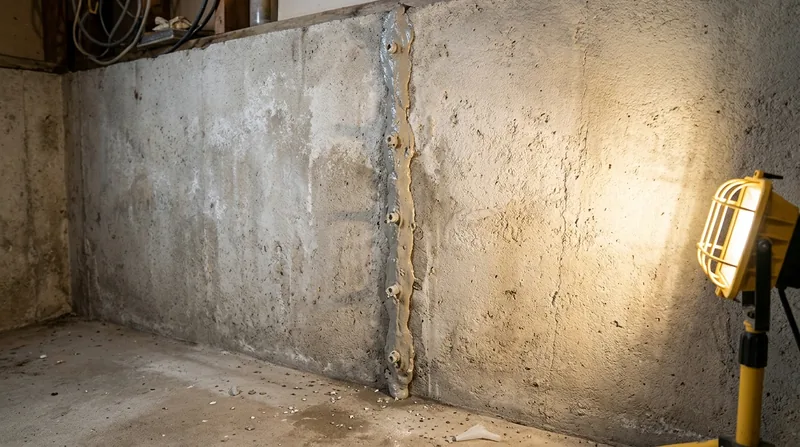
- We set injection ports along the crack and seal the surface before pumping epoxy or polyurethane.
- We inject from the bottom port up until material shows at the next port, then move up the crack.
- We trim the ports, patch the surface, and note any crack that needs monitoring or structural straps.
If the inspection shows the crack is a symptom of water pushing from outside, we say so and explain why an interior drain tile system may be the better answer than sealing the same seam every other year.
Key info: A 1950s split-level in Hockessin had three vertical cracks in a poured wall, all dry except after heavy summer rain. Injection sealed two of them. The third sat below grade where the footing drain was clogged, so we recommended drain tile repair instead of a third injection. That is the kind of call we make on site, not from a desk.
Crack Repair Methods We Use and When Each One Fits
Not every crack takes the same material. Epoxy is rigid and bonds the concrete back together, which suits a stable, non-structural crack that is not moving. Polyurethane stays flexible and foams on contact with water, which suits an active leak or a crack that opens and closes with the seasons. Structural cracks need straps or anchors, and a wet wall behind the crack often needs drainage before any injection will hold. The table below shows how we match the method to the crack.
| Approach | Description | Best for |
|---|---|---|
| Epoxy injection | Rigid structural bond pumped into ports along the crack | Stable, non-structural vertical cracks in poured walls |
| Polyurethane injection | Flexible foam that expands and seals against active water | Leaking cracks and seams that move with freeze-thaw |
| Carbon fiber straps | Straps bonded across the wall to resist bowing | Horizontal cracks and early bowing in block walls |
| Wall anchors | Anchors driven into exterior soil and tied to the wall | Bowing walls where the soil load must be pulled back |
| Drainage correction | Interior perimeter drain and sump to relieve hydrostatic pressure | Cracks that keep leaking because water is still pushing |
We pick the method from the inspection, and we tell you when a cheaper repair will hold and when it will not.
Foundation Crack Repair Cost in Wilmington: What to Expect
Most single-crack injection work in Wilmington starts at $450 and runs up from there. That starting figure covers a straightforward, non-structural vertical crack with ports set and material pumped, and it is the number we quote most often in the river neighborhoods. What moves the price is the number of cracks, the width and activity of each one, whether the wall is poured or block, and whether access is tight in a finished basement. Structural repair, strap work, and drainage correction are quoted on site because the scope depends on what the inspection finds.
A rowhouse in Little Italy with one dry vertical crack is a different job from a Hockessin walkout with three active cracks and a clogged footing drain. We price each one from the inspection, not from a phone description. It is smart to get two or three estimates and compare what each one actually includes, because a low number that only patches the surface will not hold through a Delaware freeze-thaw cycle. Our pricing overview lays out the ranges so you can compare apples to apples.
Foundation Crack Repair Near Me: How to Vet a Contractor Near Wilmington
When homeowners search for foundation crack repair near me around Wilmington, the first thing to check is whether the company is licensed and insured for structural work in Delaware. Ask for the certificate, not just a verbal yes. Get two or three written estimates that state the method, the material, and what happens if the crack reopens. Ask for references from jobs in similar housing stock, because a brick rowhouse and a poured-wall ranch fail differently. And confirm who pulls the permit if the repair is structural, since the City of Wilmington and surrounding jurisdictions vary on what triggers one.
We are a dedicated basement waterproofing specialist, distinct from a general foundation-repair firm and from a plumber, and we will tell you when your crack needs a structural engineer rather than us. Reach out through our contact page to set up the free inspection and get a written scope before any work begins.
Foundation Crack Repair in Wilmington: Pricing Guide
| Service | Price | Details |
|---|---|---|
| Single crack injection | Starting at $450 | One non-structural vertical crack, ports set, epoxy or polyurethane pumped and trimmed |
| Multiple crack injection | Starting at $850 | Two to three cracks in the same basement, priced per crack with shared setup |
| Structural repair (straps or anchors) | On estimate | Bowing or horizontal cracks need an on-site look to size straps and anchor depth |
| Drainage correction | On estimate | When hydrostatic pressure drives the leak, interior drain tile and sump are scoped on site |
| Travel | Included | in Wilmington and surrounding areas, no separate call-out or mileage fee |
| Estimate | Free | Response within 24h at (302) 573-9185, no obligation to book |
Indicative pricing, the exact cost depends on square footage, finish, and site access. Free personalized estimate within 24h at (302) 573-9185.


