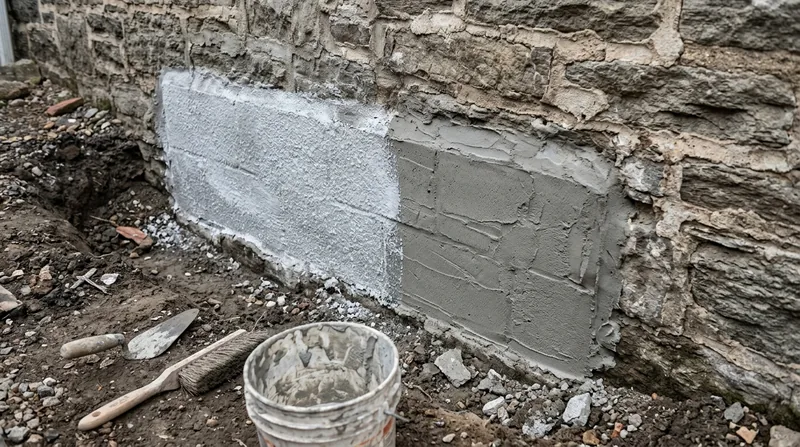




Wilmington's foundation problems start with the ground it sits on. The city grew up where the Brandywine meets the Christina, and much of that ground is weathered Piedmont rock and silty clay that holds water through spring and sheds it slowly. Rowhouses in Trolley Square and Little Italy sit on fieldstone or early block walls with clay tile drains that have been quietly failing for decades. Out in the ranches and split-levels of Brookside and Pike Creek, you get poured or block walls under yards that pool after a nor'easter. Foundation Waterproofing in Wilmington means reading the foundation type and the water source before anyone touches a wall. We handle parging, crack injection, membrane and crystalline treatments, and drainage correction matched to what your foundation actually is. If you are dealing with a wet basement and want to understand how the whole system fits together, start with our basement waterproofing overview.
Why Wilmington Foundations Take On Water
The dominant failure here is not a single bad crack. It is hydrostatic pressure building in silty clay against old masonry, plus a high water table near the rivers pushing groundwater into lower walls. Pre-1930 homes add their own problems: fieldstone walls that were never parged, mortar that has softened, and weeping tile that is clogged or collapsed. Freeze-thaw cycles then widen every joint over winter. Here is what we see most often on Wilmington foundation calls:
- Efflorescence and white salt bloom on block walls, which tells you water is moving through the masonry, not just sitting in the room.
- Horizontal cracks and inward movement on older block walls, which point to soil pressure rather than a simple leak.
- Water after rain pooling along the cove joint where the wall meets the floor, the classic sign of a failed footing drain.
- Clay tile drains in 1920s rowhouses that have silted shut and no longer carry water away from the footing.
- Downspouts dumping at the corner of the house, which turns a manageable grade problem into a wet wall.
Most of these are correctable once you know which one you are looking at, and that is what the first visit is for.
Key info: On a 1925 rowhouse off Pennsylvania Avenue, the owner had sealed the same wall crack three times. The real issue was a collapsed clay tile drain under the floor and a downspout discharging two feet from the foundation. Sealing the crack again would have done nothing.
Permits for structural foundation repair and for work that alters drainage vary by jurisdiction, so confirm requirements with the City of Wilmington's Department of Licenses and Inspections before work begins.
How We Diagnose and Waterproof a Wilmington Foundation
We start below grade and work outward. The first step is finding where the water enters and where it wants to go, because a wall that leaks at the base and a wall that is bowing need completely different answers. We check the foundation type, the grading, the downspouts, the drain tile, and the sump setup before recommending anything. Then the work follows in a fixed order:
- We walk the basement and the exterior, mapping cracks, efflorescence, and low spots in the grade.
- We identify the foundation material (fieldstone, block, or poured) and test whether the drain tile is still flowing.
- We correct grading and downspout discharge first, because it is the cheapest fix and often the actual cause.
- We repair cracks by the right method: epoxy injection for structural cracks, polyurethane injection for active leaks.
- We parge and seal masonry walls where the surface is failing, then apply a membrane or crystalline treatment suited to the material.
- We correct drainage with an interior perimeter drain, footing drain repair, or sump basin as the diagnosis calls for.
Each step is documented, so you know what was done and why.
Key info: A split-level in Pike Creek had water across the floor every spring. The walls were sound. The fix was an interior perimeter drain tied to a new sump basin, not exterior excavation. On a fieldstone wall in Bellefonte, the reverse was true: repointing and parging solved it without any drain work.
For homes where the water is coming through the wall itself rather than the floor, our basement wall sealing page covers the treatment options in detail.
Waterproofing Methods Matched to Wilmington Foundation Types
There is no single method that fits every Wilmington basement. The right choice depends on the foundation material, the water source, and whether the wall is moving. This table shows how we match approach to condition:
| Approach | Description | Best for |
|---|---|---|
| Crack injection | Epoxy or polyurethane injected through ports to fill the full crack depth | Isolated vertical cracks in poured walls |
| Parging and masonry repair | Repointing soft mortar and applying a bonded parge coat to the wall face | Fieldstone and early block walls |
| Membrane or crystalline treatment | Surface-applied waterproof coating or crystalline sealer that fills capillaries | Damp block walls with no active flow |
| Interior perimeter drain | Drain channel at the cove joint feeding a sump basin and pump | Hydrostatic pressure and floor seepage |
| Exterior footing drain correction | Excavation, dimple board, and new drain tile at the footing | Failed original drain tile and bowing walls |
The diagnosis decides the method, and we will tell you plainly when a simple crack seal is enough.
Foundation Waterproofing Cost in Wilmington: What to Expect
Most foundation waterproofing work in Wilmington starts from $3,500, and that figure buys a defined scope rather than a vague promise. A single crack injection or a parge and seal job can land near that starting point. A full interior drain tile system with a sump basin runs higher, and exterior excavation on a fieldstone wall is the most involved. The factors that move the number are the foundation type, how much wall length is involved, whether the drain tile needs replacement, and how tight the access is in a rowhouse block. Getting two or three written estimates is the smart move here, because scopes vary wildly between contractors and you want to compare the same work. Our pricing overview breaks down the ranges by job type.
Hiring a Foundation Waterproofing Contractor Near Me in Wilmington
Ask for the license and insurance certificate before anyone walks your basement, and call a reference or two from jobs in the same era of housing as yours. A rowhouse in Little Italy and a 1960s ranch in Bear do not need the same crew. Get at least two written estimates with the scope spelled out, and be wary of anyone who quotes a drain system before checking whether the downspouts and grading are the real problem. Permits for structural repair and drainage changes go through the City of Wilmington, and if you are in a neighborhood with architectural review, check that too. Reach out through our contact page to set up a free basement inspection.
Foundation Waterproofing in Wilmington: Pricing Guide
| Service | Price | Details |
|---|---|---|
| Crack injection and sealing | Starting at $3,500 | Includes epoxy or polyurethane injection on accessible cracks, with wall length and crack count driving the price. |
| Parging and masonry waterproofing | Starting at $4,200 | Covers repointing and parge coat on fieldstone or block, priced by wall area and mortar condition. |
| Interior perimeter drain and sump | Starting at $6,500 | Includes drain channel, sump basin, and pump; linear footage and discharge routing move the number. |
| Exterior excavation and footing drain | On estimate | Requires an on-site look because access, depth, and existing utilities determine the real scope. |
| Travel | Included | Covered in Wilmington and surrounding areas, with no separate call-out or mileage fee. |
| Estimate | Free | Response within 24h at (302) 573-9185, with no obligation to book. |
Indicative pricing, the exact cost depends on square footage, finish, and site access. Free personalized estimate within 24h at (302) 573-9185.


